
I’m often asked how my Parkinson’s impacts my cycling and how my cycling impacts my Parkinson’s. I have written a little about it in the past but it changes with time. So this is a snapshot of my experience of cycling across America ten years after a diagnosis of Parkinson’s. (Links to previous blogs about the impact of Parkinson’s on cycling are at the end of this blog).
Cycling demands balance, co-ordination, confidence, the ability to judge traffic conditions and to react accordingly and often quickly in response to obstacles, other road users and changing road conditions. Cycling also demands the ability to do a number of things simultaneously. Think about checking the traffic behind, signalling, slowing down, judging the speed and distance of oncoming traffic and turning across the traffic having judged that it is safe to do so. Miss out any one of these actions and the result could be disastrous.
If I tell you that Parkinson’s typically adversely affects posture, balance, co-ordination, spacial awareness, reaction times, speed of movement and the ability to multi task, a natural conclusion might be that Parkinson’s and cycling seem to be like oil and water. They just don’t mix. Yet there are many people living with Parkinson’s who enjoy and benefit from cycling regularly.
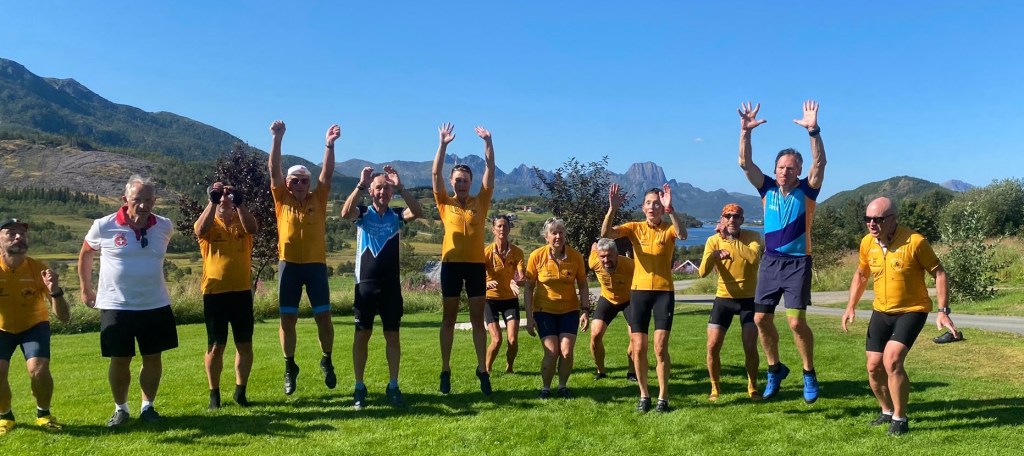
Our group of cyclists with Parkinson’s during our Norway cycling challenge 2024
Adapting – ‘New Norms’
As in so many other aspects of daily life, those of us living with Parkinson’s learn to adapt, to alter the way we do things to allow us to maintain our independence for a little longer. We adopt a ‘new normal’ and continue to adapt again and again until these changes become our ‘new norms’ and we begin to forget what the ‘old norms’ looked like.
Before I even get on my bike, Parkinson’s presents challenges. My hands frequently refuse to move in the way I ask them to and fastening shoes, zips, helmets, putting on gloves, programming my Garmin, attaching my phone to it’s holder and pumping up tyres all become difficult, time consuming and at times impossible to do. Trying to rush makes it all the harder so I plan and prepare for each ride well in advance. What used to be a mental checklist of all the things I need to do which just prior to leaving for a ride is now a written checklist used to prepare everything the evening before I plan to set off.
The combination of symptoms and their severity vary significantly throughout the day. They can be influenced by tiredness, stress, the timing of medication, what I have eaten, when I have eaten, my hormones, lack of sleep and much more. Or, as is often the case, there is no discernible reason and symptoms come and go entirely at their own discretion regardless of how inconvenient it may be. It is exactly the same when I am cycling. No two rides are ever the same. I regularly have to react to changes in symptoms as each ride progresses. It adds to the challenge of cycling but I am grateful that I still find it possible to cycle ten years after receiving my diagnosis.
My default cycling position is asymmetrical. My right leg turns inwards at an awkward angle. My left leg powers approximately 65% of my pedalling and my right leg around 35%. I can influence this slightly if I concentrate on making my right leg work harder but as soon as I stop focussing on this, my leg defers to its default position and power output. Sometimes I can clip in and out of pedals easily and other times I can have great difficulty. For our cycle across America, I used flat pedals to have one less thing to think about! I notice however that increasingly, as I tire, my right foot slips off the pedal. DI2 (electronic gear shifters) have helped me overcome the problem of the times when my hands do not having sufficient power or dexterity to change manual gears. I have yet to find a solution to changing an inner tube as for the most part I have to rely on others to do this for me.
I have two cycling personalities. One when my Parkinson’s symptoms are well controlled (‘on time’). At these times I can be a relatively fast, confident and competent cyclist. I feel steady, balanced and in control. I can negotiate my way around obstacles and through narrow openings without a problem, I am confident in my ability to react quickly as required. I can cycle alongside others and chat while cycling. These actions come naturally and without undue effort. I don’t have to think to too hard. I can simply relax and enjoy cycling.
‘Off Time’
My other cycling personality appears unpredictably, when my Parkinson’s symptoms are not well controlled (‘off time’). At these times, the symptoms really interfere with my ability to cycle. When experiencing ‘off time’, my posture is hard to control, I lean to one side, I become slow and unsteady, unbalanced and unable to react to changes as quickly, either mentally or physically. I have no hope of negotiating my way through a narrow opening or maintaining my balance while moving slowly up a hill. As a result of this, I become a slower and more hesitant cyclist. I have to concentrate hard to follow directions, to remember my left from my right (yes, really) and to remember which gear shifter to move to make the gears easier or harder. I have absolutely no hope of holding a conversation while I’m like this. I need all my concentration just to stay upright and to focus on the road ahead. I tire much more easily during ‘off time’.
Recently during ‘off time’ I have found it difficult to get on and off my bike. At times I have difficulty pushing off and starting to cycle. It has also recently become difficult to co-ordinate slowing down, staying upright and putting one foot on the ground as I stop. During ‘on time’ I don’t have to think about these things, they simply happen with no conscious thought or effort.
‘On time’ and ‘off time’ are typically related to medication. If the medication is working well, symptoms are less noticeable but when the effect of the medication is wearing off, a range of symptoms become more problematic. Parkinson’s is a progressive condition and therefore typically, existing symptoms worsen over time and new symptoms present themselves. As Parkinson’s progresses, ‘off time’ typically becomes more unpredictable and lasts for longer.
For the first few weeks of our cycle across America, fatigue was a problem.
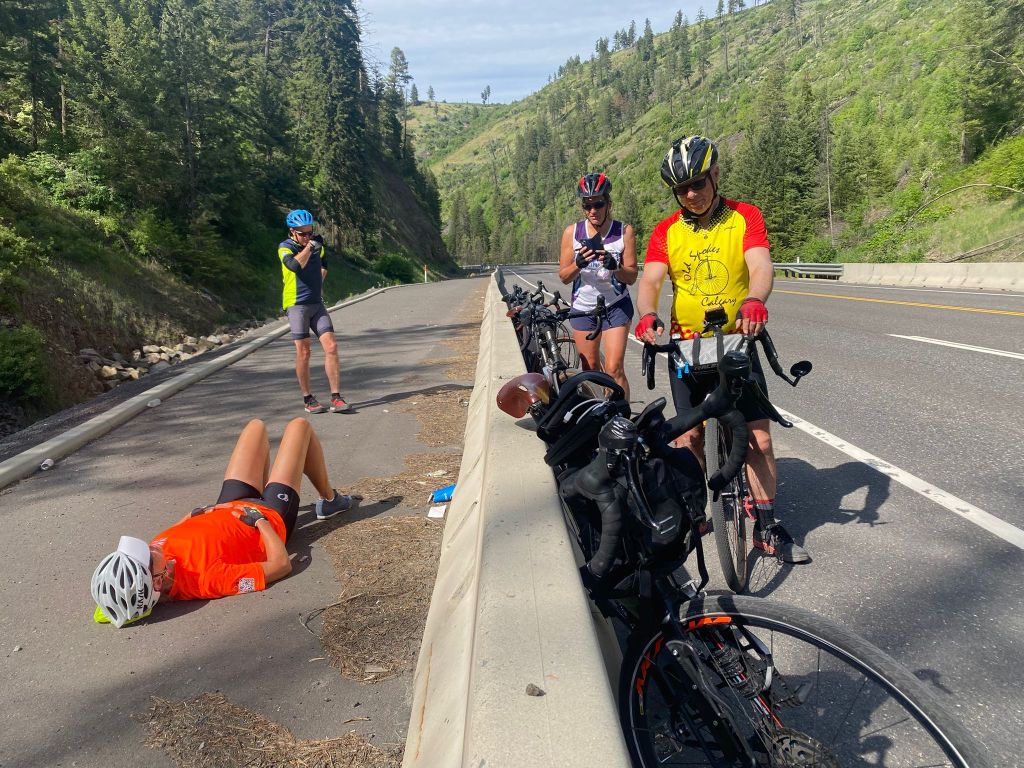
Feeling Fatigued!
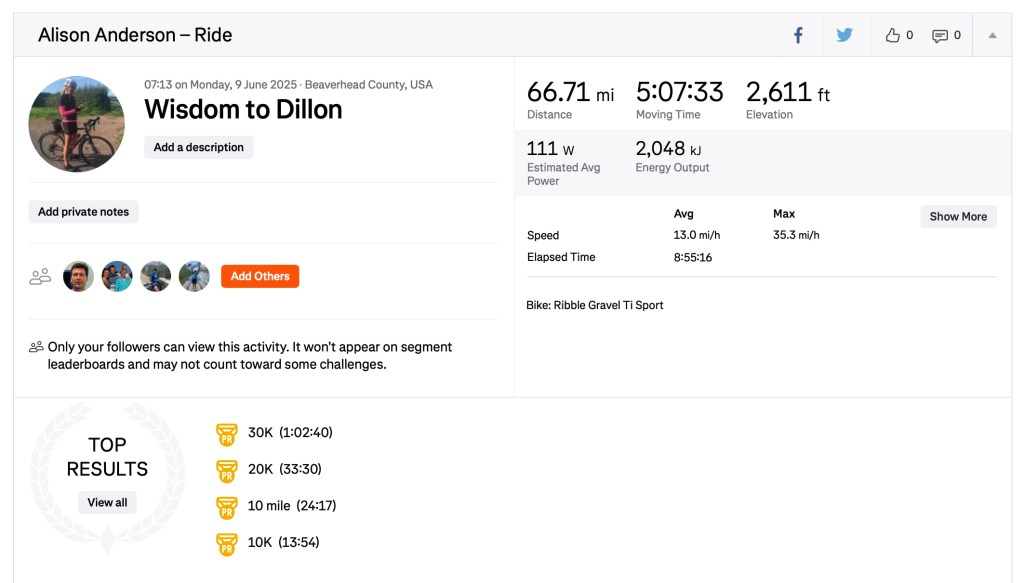
The hills were hard and of course we had the Rockies to contend with. The temperatures were high and some days we were cycling 70+ miles. It must have been good training because as time went on, the cycling became easier, the hills less onerous. my ‘off time’ reduced and my symptoms were on the whole, less problematic. I felt my posture had improved and my cycling was faster. The others noticed these changes too. My Strava data reflected what I was feeling when it informed me that during this time I achieved my fastest 10km, 20km and 30km since records began in 2017!
Research has shown that regular exercise can delay the progression of Parkinson’s. This is something that no medication has been able to achieve yet. This is usually sufficient incentive for me to get on my bike but I know that the benefits of cycling go way beyond the physical benefits. The psychological benefits of being outdoors and of doing something that slows down the progression of Parkinson’s are huge. Add to that the social aspect of cycling with friends and of connecting with a large community of people living with Parkinson’s who enjoy cycling and it becomes fun and sociable. I feel better when I have been cycling, physically and psychologically.
A Team Effort
Of course, there is no way I could have cycled across America alone. John, Caroline and Paul have all cycled with me over many years. They know me well. They each understand how Parkinson’s affects me and they were an enormous support to me. They would plan the routes, organise stops for food and drink and lead the way, so all I had to do was to follow them and focus on cycling. They made sure I kept well hydrated, that I had regular stops, that I ate sufficient to fuel my cycling and that I took my medication on time. They encouraged me and cajoled me when necessary. They were quite simply were the best support team I could ask for.
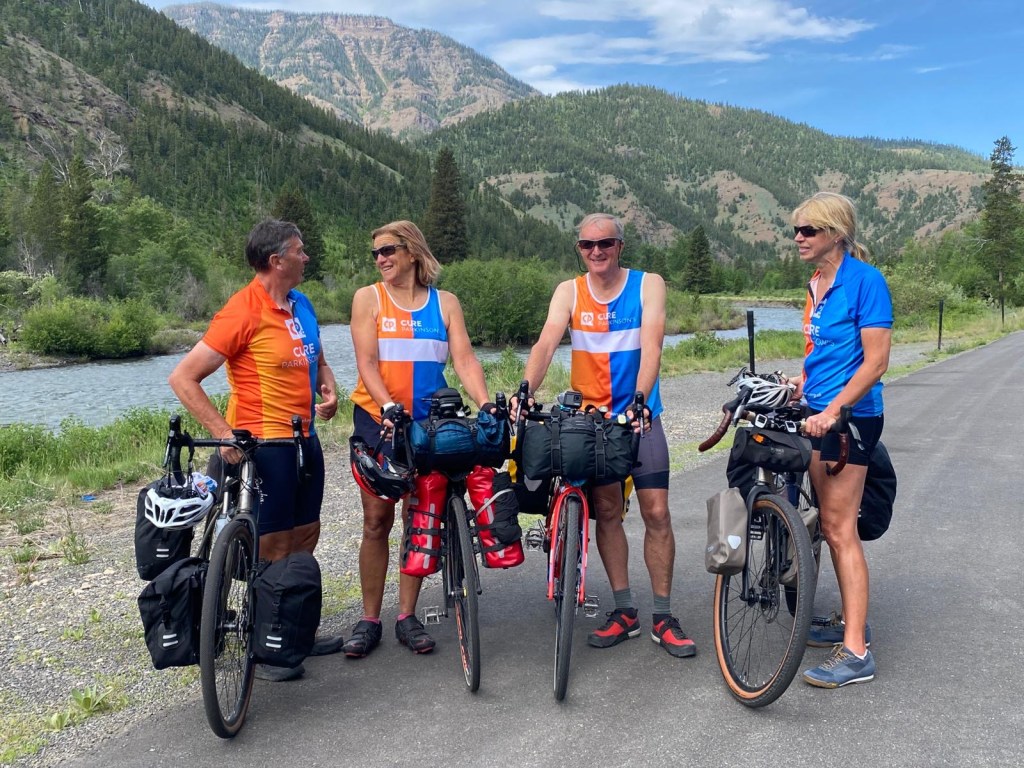
Cycle Across America Support Team
This is an account of my experience of cycling with Parkinson’s. Everyone’s experience will be unique to them.
 Challenging Times
Thank you for sharing Alison, you are quite amazing with your determination and tenacity and you do it all with such grace. It was both an honour and a joy to have been able to share a small part of the journey with you. To cycle 4,500 miles across America is challenging in itself but to do it with all the complications brought about by Parkinson’s is nothing short of incredible. Xxx
I have recognized myself in many of your posts…posture issues, turning tight especially to the right, start and stopping issues, sensory overload,stamina and so much more. I was diagnosed in 2020 but knew something was not right in 2018. I have enjoyed long distance cycling since 1998. I still ride ,just not like I used to. I have recently bought an e bike which is keeping me riding. Following your blog has been great..thanks
Jane
Get Outlook for Androidhttps://aka.ms/AAb9ysg
Such an insightful update. Truly in awe of how you cycle such long distances whilst juggling with what Parkinson’s decides to throw your way each day … and then express it all so eloquently 🙌🏼 🚴🏼♀️🌟 x
Good to read more reflections Alison now this particular challenge is over x